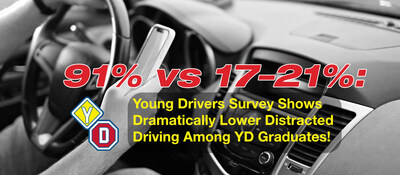
91% of Young Drivers Graduates avoid Distracted Driving vs 17-21% National Averages
PR Newswire
TORONTO, Feb. 17, 2026
Young Drivers of Canada 2026 Graduate Survey results revealed that 91% of students who completed the Young Drivers program more than two years ago reported never or rarely driving distracted, and continue to demonstrate strong, lasting habits in hazard identification, predictive driving and risk avoidance. The survey, which included over 1,000 graduates shows that they consistently apply core cognitive driving habits taught in the Young Drivers program - without distraction - long after formal instruction ends.
TORONTO, Feb. 17, 2026 /PRNewswire-PRWeb/ -- A new national survey from Young Drivers of Canada (YDC) reveals a powerful contrast in distracted driving behaviour: 91% of YDC graduates report they never or rarely drive distracted, compared to only 17–21% of Canadian drivers nationally who report driving without distraction.
Predictive Habits Linked to Lower Risk
At a time when distracted driving continues to contribute significantly to collisions across North America - including 3,275 fatalities in distraction-affected crashes in the United States in 2023 according to the U.S. National Highway Traffic Safety Administration (NHTSA) - the findings suggest that predictive, habit-based driver education may offer a scalable prevention solution. Canadian benchmark note: Publicly reported Canadian self-reported driving behaviour surveys conducted by organizations including Transport Canada, CAA, Rates.ca and provincial road safety authorities indicate that only approximately 17–21% of Canadian drivers report driving without distraction.
Predictive Training: A Prevention Strategy, Not Just a Warning
Most distracted-driving initiatives focus on enforcement or public awareness messaging. Young Drivers takes a different approach: train the brain before the behaviour becomes a risk.
Graduates of the program reported strong long-term retention of core defensive habits that directly counter distraction:
- 97% check blind spots before every lane change
- 95% adjust speed or position to avoid developing hazards
- 94% recognize and respond early to traffic flow changes
- 92% scan vehicles around them for changes in movement
- 90% maintain safe following distances
- 80% maintain a 12–15 second eye-lead time
"These aren't compliance behaviours—they're cognitive habits," said Andrew Marek, Chief Growth Officer & Chief AI Officer of Young Drivers of Canada. "When attention is occupied with anticipation, distraction becomes less likely."
Extending Prevention Beyond the Classroom: DriversCoach™ App
To reinforce safe driving habits beyond in-car lessons, Young Drivers has expanded its prevention strategy through the DriversCoach™ Mobile App, a digital companion platform designed to support both new and experienced drivers.
The app integrates:
- Interactive micro-lessons focused on hazard perception and predictive scanning
- Reinforcement modules for eye-lead time, space management, and blind-spot awareness
- Habit-building reminders aligned with the Collisionfree!® Approach
By delivering short, focused training experiences and real-world reinforcement, DriversCoach helps ensure that defensive habits remain active long after formal training ends. "Learning doesn't stop when a student receives their license," Marek added. "DriversCoach helps keep predictive habits sharp - and that's critical to reducing distraction over time."
StreetSmart™: Cognitive Insight Meets Driver Education
Young Drivers has also introduced StreetSmart™, a new cognitive evaluation and personalization platform that assesses how individuals perceive risk, process information, and respond to developing hazards. StreetSmart™ is designed to:
- Identify cognitive strengths and gaps related to hazard recognition
- Personalize training recommendations
- Support long-term behavioural improvement
Rather than treating distraction as a standalone issue, StreetSmart evaluates the underlying cognitive engagement patterns that influence attention, anticipation, and decision-making. "Distracted driving isn't just about devices - it's about cognitive load," Marek explained. "StreetSmart allows us to understand how drivers process risk, and tailor training accordingly."
Extending Prevention Beyond New Drivers: A New Focus on Senior Drivers
Young Drivers of Canada said the survey's results reinforce a broader principle: cognitive engagement reduces risk across all age groups. While distracted driving is often framed as a youth issue, safe driving is strongly tied to hazard perception, visual scanning, decision-making and attention management - skills that matter throughout a driver's lifetime. YDC's goal is proactive support of senior drivers in helping them maintain confidence and independence through cognitive insights and reinforcement with predictive habit refreshers.
Safer Outcomes in the Real World
Notably, the reduction in distracted driving correlates with broader safety outcomes reported in the YDC 2026 Survey of Graduates that completed their driver training more than two years ago, that:
- 91% report no collisions or only not-at-fault collisions
- 67% say they have avoided a collision because of a skill learned at YDC
- 88% report no traffic tickets
- 80% report no speeding tickets
- 81% report no collision-related insurance claims
Graduates also report high levels of calmness and confidence:
- 92% feel more confident behind the wheel
- 83% say their anxiety was reduced
- 87% describe themselves as calm while driving
- 92% report increased awareness as both driver and passenger
A Signal for Policy, Insurance, and Road Safety Leaders
The findings suggest that distracted driving prevention may be more effectively addressed through predictive, habit-based training supported by technology and cognitive insights. To this end survey graduates overwhelmingly support stronger safety measures:
- 90% believe hazard perception should be emphasized more in government road tests
- 86% support mandatory formal driver education
- 86% would participate in refresher training if it reduced insurance rates
- 69% support telematics or in-vehicle monitoring tools
"If we're serious about reducing distracted driving," Marek concluded, "we need to move beyond warnings and penalties. We need to build attention into the way drivers think."
About Young Drivers of Canada
Young Drivers of Canada is a national leader in driver education, known for its Collisionfree!® Approach and emphasis on predictive driving, hazard perception, and lifelong safety habits. Through research-driven curriculum, in-vehicle coaching, and technology-enabled platforms including the DriversCoach™ App and StreetSmart™ cognitive evaluation system, Young Drivers has trained over 1.4 million graduates to reduce collisions - not just pass road tests.
For more information, visit yd.com.
Media Contact
Andrew Marek, Young Drivers of Canada, 1 4163227000 231, amarek@yd.com, https://yd.com
Ursula Romeo, Young Drivers of Canada, 1 4163227000 245, uromeo@yd.com, https://yd.com
 View original content to download multimedia:https://www.prweb.com/releases/91-of-young-drivers-graduates-avoid-distracted-driving-vs-17-21-national-averages-302688198.html
SOURCE Young Drivers of Canada