CoinEx Chief Analyst Jeff Ko, BlockBeats researcher c00k1e (Cookie), and Bitcoin.com Growth Lead Sal Selamat-Sim examine the forces behind Bitcoin’s latest breakout, the signals that could confirm its sustainability, and what the move could mean for the next phase of the crypto market
HONG KONG, Aug. 25, 2026 (GLOBE NEWSWIRE) -- Bitcoin has pushed above $80,000, reaching its highest level in roughly three months and extending a rally that has rapidly reshaped market sentiment.
Only days earlier, Bitcoin had broken above $75,000 after spending nearly two months trading largely within the $60,000–$66,000 range. At the time, the market was already debating whether the move represented the beginning of a more durable breakout or an overreaction driven by short-term catalysts.
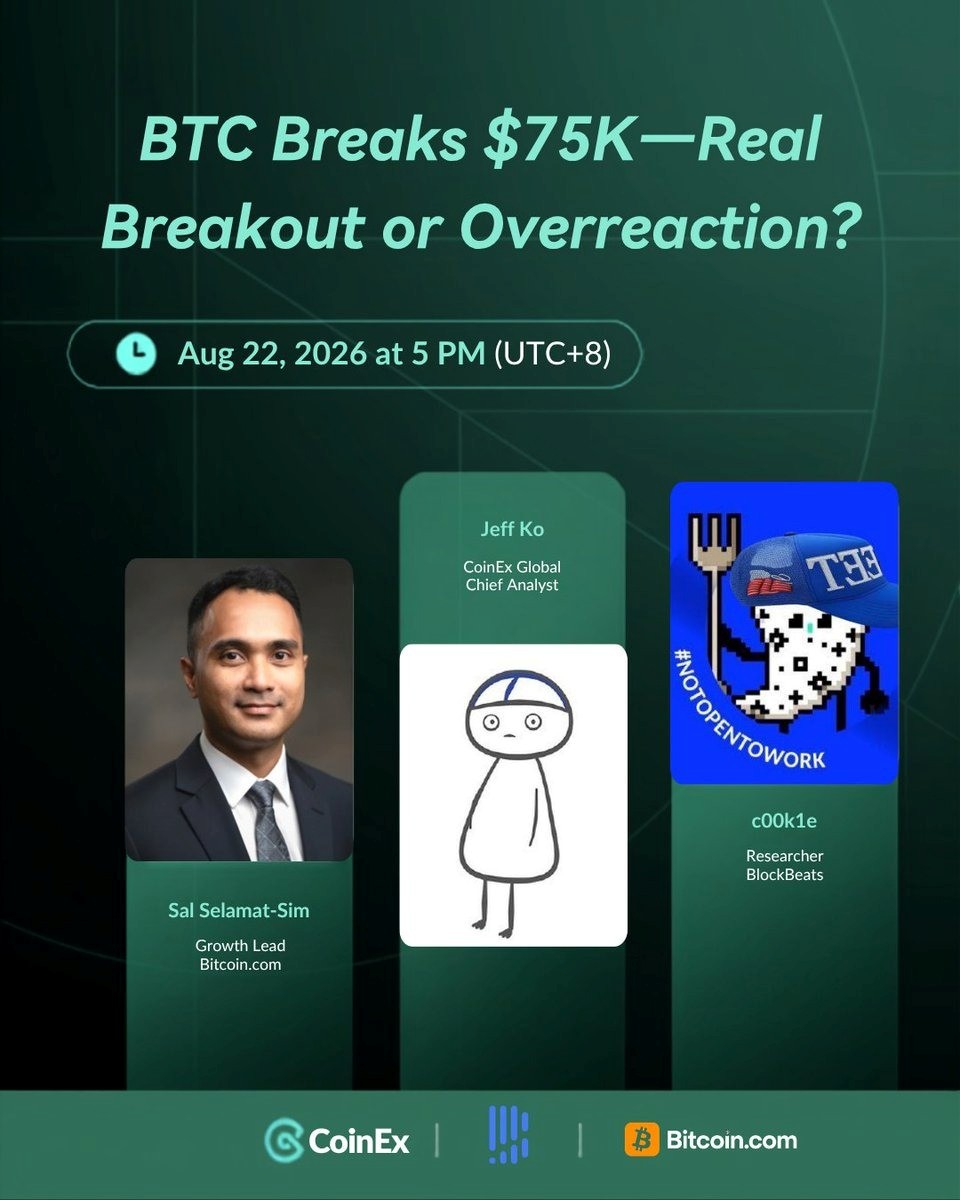
That question was at the center of an X Spaces discussion held on August 22, featuring Jeff Ko, Chief Analyst at CoinEx; c00k1e (Cookie), Researcher at BlockBeats; and Sal Selamat-Sim, Growth Lead at Bitcoin.com.
Since then, Bitcoin’s move above $80,000 has added further momentum to the debate.
The discussion examined three central questions: what drove Bitcoin’s breakout, what would confirm that the move is sustainable, and how Bitcoin’s strength could influence liquidity and opportunities across the broader crypto market.
Macro Conditions, ETF Demand and Short Positioning Drove the Breakout
The panel broadly agreed that Bitcoin’s rally was not the result of a single catalyst.
Jeff Ko identified developments in U.S. Treasury policy as one of the most immediate macro drivers. Expanded purchases and buybacks of longer-dated Treasuries contributed to pressure on long-term yields and the U.S. dollar, creating a more supportive environment for alternative assets and risk markets.
The macro backdrop has remained relevant as Bitcoin extended its rally above $80,000, with dollar weakness and renewed concerns around currency debasement continuing to support demand for Bitcoin and other alternative assets.
However, Jeff emphasized that the breakout was not simply the result of one policy headline.
Bitcoin had spent roughly two months trading within the $60,000–$66,000 range while bearish positioning continued to build. Once sentiment shifted, crowded short positioning became an important source of upward momentum.
Jeff noted during the discussion that approximately $2.7 billion in short positions were liquidated during the initial move, accelerating the rally as leveraged bearish positions were forced out of the market.
Cookie highlighted Bitcoin ETF flows as another important source of support.
He noted that spot Bitcoin ETFs had recorded approximately $1.6 billion in net inflows across four trading days, suggesting that institutional and ETF-related demand remained active even before price momentum fully accelerated.
In Cookie’s view, those flows suggested that Bitcoin may already have completed an important part of its correction phase before the breakout.
Sal Selamat-Sim also pointed to market positioning as a key factor. With many traders expecting further downside, a shift in momentum created the conditions for a sharper and faster repricing.
Taken together, the discussion suggested that Bitcoin’s breakout was driven by a combination of three major forces:
a more supportive macro environment, continued ETF-related demand, and a market that had become heavily positioned for further downside.
From $75K to $80K: The Bigger Question Is Whether Bitcoin Can Build a New Base
Bitcoin’s move above $80,000 strengthens the short-term momentum case, but the panel emphasized that price alone is not enough to confirm a sustainable trend.
Jeff argued that the healthiest confirmation may eventually come from something less dramatic: stability.
“The confirmation for me might be Bitcoin becoming boring again.”
Rather than seeing Bitcoin immediately accelerate through successive price levels, Jeff said a healthier market structure would involve the asset establishing a new trading range and allowing spot demand to build beneath the move.
At the time of the AMA, he highlighted the $72,000–$75,000 zone as an important area to watch.
That range had previously acted as resistance. If it can now function as support after Bitcoin’s move toward and above $80,000, it would provide stronger evidence that the market has undergone a meaningful structural shift.
Jeff also emphasized that the source of demand matters.
“I would prefer to see the spot market lead and then the leverage follows.”
A breakout supported by spot buying and sustained ETF demand would provide a stronger foundation than one driven primarily by derivatives and speculative leverage.
By contrast, rapidly increasing open interest and funding rates without a corresponding rise in spot demand could indicate that speculative excess is rebuilding.
Cookie and Sal also highlighted the importance of time horizon.
Bitcoin’s move above $80,000 has strengthened momentum, but sharp short-term volatility remains possible after such a rapid advance.
The key question is therefore no longer simply whether Bitcoin can break resistance, but whether the market can convert the breakout into a durable support structure.
What Could Bitcoin’s Strength Mean for Altcoins?
Bitcoin’s continued rally has also revived expectations that liquidity could eventually rotate into the broader crypto market.
The panel, however, cautioned against assuming that the current cycle will automatically follow the pattern seen in 2021.
Sal noted that today’s crypto market is significantly more fragmented.
Capital is moving across a wider range of ecosystems, narratives, and asset categories, including meme coins, emerging blockchain networks, infrastructure projects, and platform-specific opportunities.
As a result, the next phase may be defined less by a broad “altseason” and more by selective rotations into specific sectors and narratives.
Cookie argued that Bitcoin is still absorbing a significant share of market liquidity.
While BTC remains in a strong and relatively volatile trend, broader rotation into altcoins may take time.
Jeff expressed a similar view.
When Bitcoin is moving aggressively, capital tends to concentrate in the market’s largest and most liquid asset. Once Bitcoin enters a more stable consolidation phase, investors may begin searching for higher-beta opportunities elsewhere.
Two indicators could therefore become increasingly important:
Bitcoin dominance and ETH/BTC performance.
A sustained decline in Bitcoin dominance could indicate that liquidity is beginning to move into the broader crypto market.
Meanwhile, stronger ETH/BTC performance could signal renewed interest in major altcoins.
Jeff also highlighted regulatory developments as a potential longer-term catalyst.
Progress around frameworks such as the CLARITY Act could be particularly important for altcoins by reducing uncertainty around asset classification and opening a clearer path for broader market participation.
The panel’s overall view was that Bitcoin strength alone does not guarantee a market-wide rally.
Instead, opportunities are likely to emerge selectively across narratives, ecosystems, and projects that can attract sustained liquidity.
Key Market Signals to Watch After Bitcoin’s Move Above $80K
With Bitcoin now trading above $80,000, the next phase will depend increasingly on the quality of the demand supporting the move.
Several indicators will be important to monitor.
ETF Flows
Continued net inflows into spot Bitcoin ETFs would suggest that institutional and longer-term demand remains supportive.
Spot Market Demand
A rally led by spot buying would indicate healthier participation than one driven mainly by derivatives.
Jeff’s preference for the “spot market to lead” remains especially relevant after such a rapid price move.
$72K–$75K Support Zone
The former resistance zone remains an important structural reference point.
If buyers continue to defend this area during pullbacks, it would strengthen the case that Bitcoin has established a higher market base.
Open Interest and Funding Rates
Rapid growth in leverage without matching spot demand could signal increasing correction risk.
The initial rally already demonstrated how quickly crowded leveraged positions can be unwound.
$70K and the 21-Week Moving Average
Jeff also identified the $70,000 area and the 21-week moving average as broader reference points.
A sustained weekly move below these levels could weaken the breakout structure and suggest that Bitcoin needs more time to consolidate.
For investors who missed the initial rally, Jeff cautioned against responding by aggressively increasing leverage.
“You don’t need leverage to express a bullish view after the market just demonstrated what it can do to leveraged positions.”
The message is especially relevant after Bitcoin’s extension above $80,000: stronger momentum does not eliminate volatility risk.
A More Selective Crypto Market May Be Taking Shape
Bitcoin’s move above $80,000 and its return to a three-month high mark an important shift in short-term market structure.
But the breakout itself is only part of the story.
The sustainability of the rally will depend on whether spot and ETF demand remain strong, whether leverage stays under control, and whether former resistance levels can become durable support.
At the same time, the discussion between CoinEx, BlockBeats and Bitcoin.com highlighted a broader change taking place across the crypto market.
The traditional cycle in which Bitcoin rallies first and liquidity then spreads broadly across nearly all altcoins may be becoming less predictable.
Instead, future opportunities may increasingly depend on specific narratives, ecosystems, regulatory developments, and the ability of individual assets to attract sustained liquidity.
For market participants, the next phase may therefore be defined less by simply watching Bitcoin’s headline price and more by understanding:
where liquidity is moving, what type of demand is driving the market, and which sectors are beginning to attract sustained participation.
The August 22 discussion brought together perspectives from CoinEx, BlockBeats and Bitcoin.com at a pivotal moment for the market.
Bitcoin’s subsequent move above $80,000 has made the questions raised during that discussion even more relevant: whether the breakout can develop into a sustainable trend, when liquidity may begin to rotate more broadly, and whether the next phase of crypto will be defined by a market-wide rally or a more selective search for opportunities.
Contact:
CoinEx
pr@coinex.com
Disclaimer: This sponsored content is provided by the content provider and does not necessarily reflect the views of this media platform or its publisher. The information is shared for general informational purposes only and should not be considered financial, investment, or trading advice. Cryptocurrency and mining-related activities carry risks, including the potential loss of capital, and readers are encouraged to conduct their own research and seek professional advice where appropriate. Speculate only with funds that you can afford to lose.The media platform and publisher assume no responsibility for any losses or claims arising from reliance on this content. GlobeNewswire does not endorse any content on this page.
Legal Disclaimer: This article is provided on an “as-is” basis, without warranties or representations of any kind, express or implied. The media platform assumes no responsibility or liability for the accuracy, content, completeness, legality, or reliability of the information presented. Any complaints, claims, or copyright concerns related to this article should be directed to the content provider mentioned above.
A photo accompanying this announcement is available at https://www.globenewswire.com/NewsRoom/AttachmentNg/12b1f888-86b5-4a6c-97e7-d45d6c9ff8e5