Crofton, NE May 27, 2026 --(PR.com)-- River Ecosystems, Inc. Releases a Status Update, on Critical Habitat Designation, for the Missouri River Ecosystem. 26 May 2026
An ecosystem is a biological community, of interacting organisms, and the physical environment, within which these organisms evolved. The Missouri River is millions of years old. The rock, that underlies the Great Plains and Prairie Region, was laid down, during the Cretaceous, 145 million years ago. The thickness, of this Cretaceous series, is estimated at 5,000 feet (E.S. Dana and G.B. Grinnell, 1875, Reconnaissance from Carrol, Montana, to Yellowstone Park, Geological Report). At some point, millions of years later, the primordial Missouri River Basin formed, as a depression, that became the Western Interior Seaway, a vast, shallow sea, from the Arctic to the Gulf of Mexico. The Laramide Orogeny, uplifted the Rocky Mountains, between 75 and 45 million years ago, causing the sea to retreat; depositing fine alluvial soil, hundreds of feet thick, as it drained (Missouri River Geology Page, 2013).
This physical environment, that existed continually, until the early 1800s, evolved a massive assemblage, of plants and animals, owing to the meandering, miles wide river and floodplain (Hesse, L.W. 2025. “8emessourit” "The River of the Big Canoes"). Though millions of Indigenous peoples, colonized the Missouri River basin, dating back 12,000 years. “To these natives, the Earth was one’s relative, requiring respect and care, as are all animals and plant life the land supports” (Mark, J.J. 2023). All this changed when Spanish, and Anglo-Saxon settlers, exploited the land, the river, and the game. The first physical alteration, of the river, was the Government’s effort, to improve steamboat navigation, by removing large trees buried in the river, then channelization, and dams. Today, there is nothing left of the original condition, including many of the native species; however, the "busy beavers," i.e. USACE, were unable to completely divert run-off, from the mountains and the prairies. Today, hope still springs eternal. There are pathways, that will restore form, function, and life (Larry Hesse LinkedIn articles).
Section 4(a)(3) of the Endangered Species Act, requires that, to the maximum extent prudent, and determinable, the Secretary, must propose critical habitat, at the time the species is proposed to be endangered. “The Service finds, that designation of critical habitat, is not presently determinable or prudent, for pallid sturgeon, due to the paucity of information, on the species life requisites, and the wide dispersal, of limited sighting records, in recent years (Federal Register / Vol. 54, No 167 / August 30, 1989.” This gave USACE, the opportunity to leave the river, in its altered form, while searching (40 years) for an artificial solution; it failed, and this fish, as well as 40 more, and thousands of other native species are in grave danger of extinction (Hesse, L.W. “8emessourit” "The River of the Big Canoes").
River Ecosystems, Inc., (REI), while researching data for “8emessourit,” found the definition of the original condition, in Chief of Engineers Annual Reports from the 1800s. In addition, River Ecosystems, Inc, quantified, specific, original habitats, in the meander belt, from USACE topographical surveys of the entire river, in 1896, and 1923. This provided a defensible determination of critical habitat, used by all native species, not just an endangered fish and bird.
REI submitted a "Listing Petition to Revise Critical Habitat for the Missouri River Ecosystem," 5 January 2026, to the Assistant Regional, Director, Mountain-Prairie Region of the U.S. Fish and Wildlife Service; USFWS is required by statute, to respond, to Listing Petitions, within 90 days; 140 days have passed, and River Ecosystems, Inc. has not received a response. Communication with the USFWS employee, tasked with reviewing the Petition, led River Ecosystems, Inc. to believe the Service was exploring options, to decline the Petition, because, if enacted into law, it would require USACE to significantly alter current management of the channelized section. There is more than 66,000 acres of public land in 16 sites, that could be widened, to create the critical habitat, defined in the Petition, but recovery of sediment transport, and a semblance of the natural hydrograph, would guarantee recovery, of native species.
Phone calls, to Region 2, USFWS, Denver, have been unanswered. Concerned citizens, across the country, can support the Listing Petition by email, i.e, Wayne_NelsonStastny@fws.gov Please help REI, help recovery this Ecosystem.
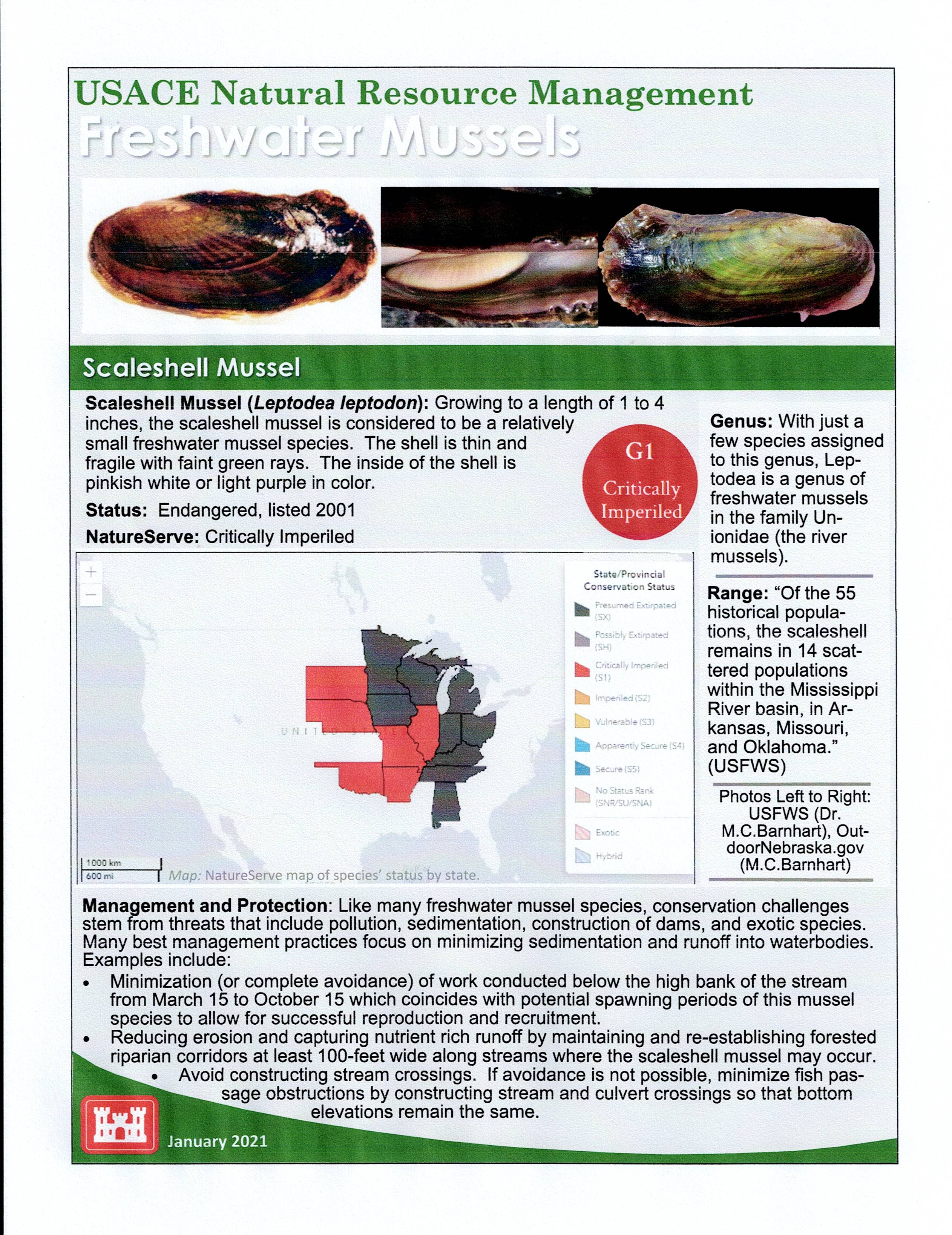
The scaleshell mussel (Leptodea leptodon) is critically endangered (Federal Listing in 2001). The founder of REI, grew up along the middle Missouri River. He found scaleshell to be abundant, on the sandbars, between the two lower-most dams in the 1960s. Fourteen mussels were known to have lived in Nebraska, most are gone or very rare.
Contact Information:
River Ecosystems, Inc
Lawrence W. Hesse
402-640-7809
Contact via Email
https://www.linkedin.com/in/larry-hesse-522ba1346/
Lawrence W. Hesse
Read the full story here: https://www.pr.com/press-release/969457
Press Release Distributed by PR.com