LEWES, Delaware, July 29, 2026 (GLOBE NEWSWIRE) -- Mirrorless Lenses Market Size, Share & Forecast Overview
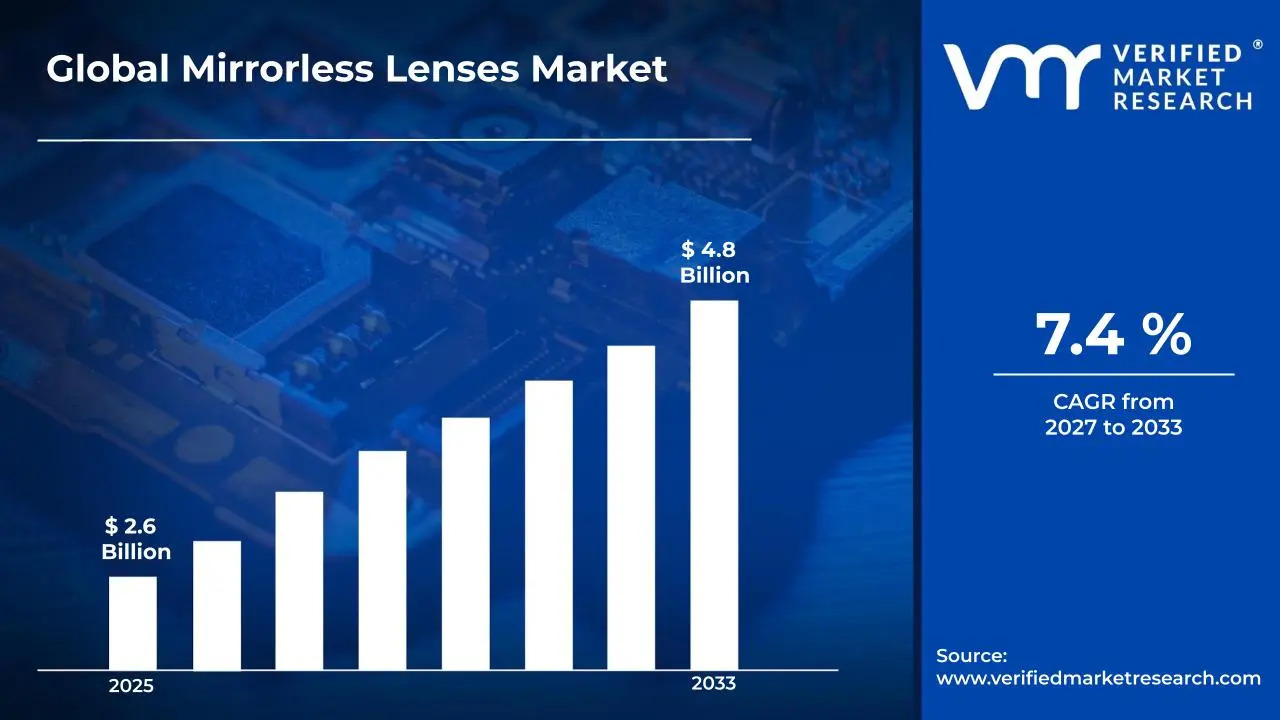
According to a new industry analysis released by Verified Market Research®, the Global Mirrorless Lenses Market was valued at $2.60 Billion in 2025 and is forecast to reach $4.80 Billion by 2033, expanding at a compound annual growth rate (CAGR) of 7.4% across the 2025–2033 forecast period. The report, titled "Mirrorless Lenses Market Size By Type (Standard & Prime Lenses, Zoom Lenses, Specialty Lenses), By Sensor Compatibility (Full-Frame, Micro Four Thirds), By End-User (Professional, Content Creators & Prosumers, Amateur), By Geographic Scope And Forecast," spans more than 240 pages and covers 15 market segments across five regions and more than ten key industry players, offering a comprehensive view of the Mirrorless Lenses Market Growth trajectory through the end of the decade.
 Download a free sample to access exclusive Insights, Data Charts, And Forecasts From Methane Analyzers Market Sample Report
The Mirrorless Lenses Market Size expansion from its 2025 base to the 2033 endpoint signals more than a simple replacement cycle. Verified Market Research® finds that demand is broadening as buyers increasingly prioritize optical performance, faster autofocus, and video-ready optics over previously bundled kit lenses. This behavioral shift, combined with continuing product roadmaps for full-frame and Micro Four Thirds lens families, is lowering the friction associated with upgrading camera bodies without requiring buyers to restart their entire lens investment - a dynamic that is expected to sustain demand for standard and prime, zoom, and specialty optics throughout the forecast window.
Market Overview: Defining the Global Mirrorless Lenses Market
The Mirrorless Lenses Market is defined as the global market for interchangeable camera lenses engineered specifically for mirrorless imaging systems. Participation in this market spans the design, development, manufacturing, and commercialization of lens products that attach to mirrorless camera bodies through manufacturer-specific or system-specific mounts. The core function of these products is to convert scene light into an image on the sensor while giving photographers and creators control over focal length, field of view, perspective, optical resolution, depth of field, and specialized performance attributes such as low-light capability, stabilization behavior, and subject-specific rendering.
Within this framework, lenses are treated as the core economic product category in the Mirrorless Lenses Market, with sensor compatibility and end-use context used to explain how customers evaluate performance and how revenue opportunity is distributed across application needs. The scope of the Mirrorless Lenses Industry is limited to mirrorless-compatible lens systems intended for still photography and video capture, including standard and prime lenses, zoom lenses, and specialty lenses. Lens-related services are included only to the extent that they are directly tied to bringing these lens products to market and supporting their functional deployment as part of the broader camera system.
Several categories are explicitly excluded from the Mirrorless Lenses Market Forecast to maintain clear scope boundaries. Standalone accessory ecosystems such as lens filters, tripods, lighting, and camera bodies fall outside the analysis unless bundled inseparably with a lens unit. Raw sensor technology, camera firmware platforms, and non-lens optical accessories are also excluded, as they do not constitute the lens as the value-driving component. Additionally, the DSLR lenses market, the cine lens market, and the smartphone camera lens module market are treated as separate analytical categories, since each differs from mirrorless lenses in mount architecture, certification requirements, pricing structure, or value-chain position.
Download a free sample to access exclusive Insights, Data Charts, And Forecasts From Methane Analyzers Market Sample Report
Key Growth Drivers Fueling Mirrorless Lenses Market Growth
Verified Market Research® identifies several interlocking forces behind the sustained Mirrorless Lenses Market Growth projected through 2033. As mirrorless camera bodies cycle faster and become comparatively interchangeable, buyers are increasingly prioritizing lens-level attributes rather than body-level upgrades, reallocating spend toward optics that deliver measurable image-quality improvements.
Rising Optical Performance Expectations
As mirrorless bodies commoditize, buyers increasingly prioritize lens-level attributes such as sharpness, autofocus consistency, and aperture performance. This shift makes standard and prime offerings more repeatable for serious imaging needs, while zoom lenses expand utility by replacing multiple focal lengths in a single optic. The net effect is a reallocation of spend from body-centric upgrades toward lens-centric performance improvements, accelerating both unit demand and the mix of higher-specification optics across the Mirrorless Lenses Market.
Sensor Format Compatibility Pressures
The parallel adoption of full-frame and Micro Four Thirds sensor systems is creating distinct field-of-view, coverage, and optical design requirements, intensifying the need for tighter tolerances in mount engineering and optical correction. Manufacturers are responding by optimizing lens designs for each sensor ecosystem, reducing performance variability such as edge degradation and distortion artifacts. This engineering loop directly strengthens upgrade cycles, as content workflows increasingly rely on predictable results across compatible camera setups.
Creator-Led Demand for Operational Versatility
Content creators and prosumers who must produce diverse shots under time pressure are shifting away from single-purpose lenses toward solutions that compress setup complexity and reduce lens changes. Zoom lenses benefit from faster scene adaptation, while specialty lenses support niche outputs such as controlled perspective effects and distinctive low-light or creative looks. As production targets tighten across both consumer and professional channels, demand for reliable, repeatable framing is expanding market volume.
Beyond these primary drivers, the broader Mirrorless Lenses Industry ecosystem is being reinforced by iterative improvements in lens-mount standardization, supply chain responsiveness, and expanding distribution reach. As component sourcing and optical fabrication processes mature, manufacturers are able to shorten design-to-production timelines, enabling faster refreshes of standard, zoom, and specialty lineups. At the same time, the consolidation of regional distribution partners and the growth of specialized retail and online channels are increasing lens availability for both full-frame and Micro Four Thirds buyers, lowering friction in purchasing and improving the perceived reliability of performance within each sensor ecosystem.
Emerging Opportunities in the Mirrorless Lenses Market
Verified Market Research® highlights several under-monetized opportunity pockets within the Mirrorless Lenses Market that are positioned to shape competitive strategy through 2033.
- Premium bundled lens ecosystems: Event coverage and studio workflows require flexible focal lengths with consistent edge-to-edge performance, yet many buyers still assemble lenses individually rather than purchasing complete bundle ecosystems. Curated standard-and-prime and zoom lens kits aligned to common client briefs can convert recurring shoots into repeat upgrades, raising both volume and average revenue per deployment.
- Compatibility-first lens planning: Camera-to-lens confidence depends on predictable autofocus behavior, stabilization pairing, and reliable exposure matching. Packaging clear compatibility guidance and performance expectations by sensor format can reduce trial-and-error purchasing and accelerate upgrades across both full-frame and Micro Four Thirds users.
- Targeted specialty lens distribution: Specialty lenses support unique storytelling needs such as macro-like effects, tight working distances, and distinctive rendering, but access often remains uneven across regions and retailers. Focused online assortments and content-guided selection tools can reduce discovery barriers and improve conversion.
- Ecosystem-level supply chain optimization: Supply chain improvements that increase availability for high-turn SKUs and specialty backorders can reduce lost sales, while clearer sensor-compatibility messaging can reduce warranty disputes and return rates, enabling new partnerships between lens makers, camera brands, and reseller networks.
Download a free sample to access exclusive Insights, Data Charts, And Forecasts From Methane Analyzers Market Sample Report
Market Challenges and Restraints
Despite favorable growth dynamics, the Mirrorless Lenses Market faces several structural restraints identified in the Verified Market Research® analysis.
Pricing and Total Upgrade Costs
Mirrorless lenses often require simultaneous investment in compatible bodies, mounts, and accessories, creating upfront cost friction. As households and smaller studios optimize spending, purchases shift from immediate replacement toward delayed, model-by-model upgrades, extending decision timelines and compressing order frequency across standard and zoom categories.
Compatibility Fragmentation
Lens behavior and autofocus performance can vary across sensor formats, mount standards, and firmware interactions. Uncertainty about how a lens will render on full-frame versus Micro Four Thirds systems increases testing and configuration effort, driving more conservative purchasing patterns, particularly among amateurs and first-time upgraders.
Manufacturing Lead Times and Supply Variability
Mirrorless lenses depend on precision optics, specialized coatings, and tightly controlled assembly tolerances. Disruptions in optical component supply or production capacity can delay shipments and create uneven inventory across regions, limiting the ability to maintain breadth in standard and prime lineups and slowing the timely rollout of zoom and specialty designs.
Technology and Innovation Trends
The report identifies technology as a primary determinant of how the Mirrorless Lenses Market evolves from a camera accessory category into a broader capture platform serving multiple skill levels.
Adaptive Optical Correction
Lens innovation is increasingly targeting consistency across conditions that typically degrade image quality, such as off-axis subjects and variable shooting distances. Refined optical element configuration addresses field curvature and other imaging distortions, producing more stable rendering across standard-and-prime, zoom, and specialty lens categories.
Electromechanical Focusing Integration
Mirrorless adoption is closely tied to how quickly lenses can lock focus and how predictably that focus holds during continuous capture. Innovations in internal focusing mechanisms and lens-to-camera control logic reduce lost frames for moving subjects, improving capture efficiency for content creators and supporting tighter production timelines for professionals.
Sensor-Format Aware Design
Designing for sensor compatibility changes how lens teams manage image coverage, micro-contrast, and corner rendering. Sensor-format aware engineering aligns optical coverage with the characteristics of full-frame and Micro Four Thirds systems, improving usability across end-user segments and expanding application scope from wide-angle environmental storytelling to compact travel and street shooting.
Industry Use Cases and End-User Segments
The Verified Market Research® report frames Mirrorless Lenses Market demand around three principal end-user categories, each with distinct purchasing behavior.
Professional Users
Professionals typically require optical consistency, reliable autofocus characteristics, and dependable performance across demanding production environments, supporting ongoing refresh and system-building. In press, sports, and live-event coverage, camera operators depend on zoom lenses to maintain composition while subjects move across the frame without swapping optics mid-sequence, since production risk is tied directly to capturing the shot in sequence.
Content Creators and Prosumers
Content Creators & Prosumers are frequently the primary driver of volume expansion because they tend to adopt mirrorless platforms early and then expand lens assortments as production requirements mature. In creator workflows that involve interviews, b-roll, product setups, and environmental shots, standard and prime lenses are commonly used to control aesthetic characteristics and manage low-light constraints indoors, while zoom lenses fill gaps when setups must be adjusted quickly during travel.
Amateur Users
Amateur buyers usually follow a slower upgrade cadence, but their category expansion can still lift market scale when new mirrorless bodies and bundled starter kits create a downstream demand funnel for additional focal lengths. Adoption for this segment generally progresses from versatile coverage toward more targeted optics once specific limitations, such as low-light clarity or subject isolation needs, become apparent.
A further application highlighted in the report is specialized imaging such as macro detail capture and astrophotography, where specialty lenses address use cases limited by optical capability at extreme conditions - for example, close-focusing performance for fine texture rendering or reliable imaging under scarce light for astrophotography setups.
Download a free sample to access exclusive Insights, Data Charts, And Forecasts From Methane Analyzers Market Sample Report
Regional Outlook: Mirrorless Lenses Market Analysis by Geography
Verified Market Research® segments the Global Mirrorless Lenses Market across five regions - North America, Europe, Asia Pacific, Latin America, and Middle East & Africa - each showing distinct demand maturity shaped by camera ecosystem adoption, creator economics, and the local pace of optical technology refresh cycles.
North America
North America behaves as a mature but innovation-sensitive segment of the Mirrorless Lenses Market, driven by a concentrated base of professional imaging users, an established media production infrastructure, and strong technology adoption among content creators. Demand is pulled by use-case specificity, with creators and prosumers selecting lenses based on autofocus performance, low-light capability, and interchangeable lens flexibility for fast turnaround production schedules. The region's mature supply chain and distribution infrastructure support faster replenishment and shorter lead times for premium lens SKUs, while a mix of professional spending and creator monetization supports a higher share of mid-to-premium lens purchases, including specialty lenses for defined creative tasks.
Europe
In Europe, Mirrorless Lenses Market demand is shaped less by raw consumer experimentation and more by regulatory discipline, harmonized standards, and quality certification expectations. The region's mature camera ecosystem and dense cross-border retail channels support consistent availability of full-frame and Micro Four Thirds lens systems, while compliance requirements influence product documentation, materials, and safety testing. Industrial integration across major European economies encourages component sourcing and faster iteration cycles, though innovation is channeled through established qualification processes, favoring optical reliability, repeatable performance, and serviceability across Professional, Content Creators & Prosumers, and Amateur segments.
Asia Pacific
Asia Pacific is the largest regional contributor to the Mirrorless Lenses Market, commanding an estimated 38% share, driven by both adoption of mirrorless capture systems and downstream demand from imaging, media production, and industrial documentation workflows. Economic maturity varies across the region, with more stable camera-lens demand in Japan and Australia contrasted by faster device refresh cycles and broader price-performance adoption in India and parts of Southeast Asia. Rapid industrialization, urbanization, and large population bases increase opportunities for content creation and e-commerce visibility, while manufacturing scale and cost-competitive component sourcing support lens availability across multiple price tiers - reinforcing Asia Pacific's position as the market's manufacturing-and-adoption anchor.
Latin America
Latin America represents an emerging but uneven segment of the Mirrorless Lenses Market, with adoption expanding gradually across Brazil, Mexico, and Argentina. Demand for standard and prime, zoom, and specialty mirrorless lenses is increasingly shaped by economic cycles, where consumer electronics purchasing power and discretionary spending fluctuate with inflation and currency volatility. Investment in media production, e-commerce retail, and creator-led content workflows is developing in pockets rather than uniformly across the region, and import reliance means lens availability remains dependent on international logistics and distributor allocations.
Middle East & Africa
The Middle East & Africa region behaves as a selectively developing segment of the Mirrorless Lenses Market rather than a uniformly expanding one. Demand is concentrated in Gulf economies, South Africa, and a smaller set of urban and institutional hubs where content production, media digitization, and professional imaging workflows are most active. Infrastructure gaps and uneven logistics create variability in retail availability, service coverage, and pricing consistency across countries, while policy-led digitization and diversification initiatives in Gulf economies are accelerating adoption of professional media tools and creator-focused gear in specific cities.
Download a free sample to access exclusive Insights, Data Charts, And Forecasts From Methane Analyzers Market Sample Report
Competitive Landscape of the Mirrorless Lenses Market
The competitive structure of the Mirrorless Lenses Market is multi-tier and moderately fragmented, with competition split between camera-platform ecosystems and independent lens specialists. Differentiation is driven less by branding and more by measurable lens attributes such as optical performance across focal lengths, autofocus reliability, lens-to-camera compatibility, mount ecosystem breadth, and software-assisted features. Global players set baseline engineering expectations through iterative firmware and mount support, while regional and niche suppliers influence availability and cost of ownership through alternative lens lineups.
- Sony: Plays an integrator role by aligning lens roadmaps with its full-frame mirrorless ecosystem, emphasizing performance pathways that work with in-camera processing. Sony leads the market due to advanced lens ecosystems and strong full-frame adoption, with mount longevity and coordinated lens-feature development reducing compatibility friction for professionals and high-output creators.
- Canon: Functions as an ecosystem anchor focused on predictable shooting outcomes for professional workflows and creator use cases, emphasizing integration between lens optics, autofocus systems, and image-processing pipelines to improve consistency for unpredictable subjects.
- Sigma: Operates as a specialist-scale competitor that challenges ecosystem pricing and expands choice through independent lens engineering, targeting standard primes, higher-performing zoom ranges, and focal-length gaps under-served by platform owners.
- Leica: Positioned as a premium brand with outsized influence through perceived optical refinement, build quality, and lens character within full-frame systems, setting reference points for specialty and portrait-oriented optics.
- Samyang: Competes as a value-and-niche specialist, expanding access to distinctive lens capabilities, particularly specialty focal lengths and effect-oriented designs sought by content creators and prosumers.
- Additional participants: Panasonic and Olympus hold meaningful influence in the Micro Four Thirds ecosystem, while Fujifilm and Fujinon act as platform-led contributors shaping lens performance expectations for their sensor formats. Pentax and other independent participants add further competitive pressure in narrower, community-specific segments.
Collectively, these players support a layered competitive environment in which ecosystem owners set integration benchmarks, independent specialists expand choice and influence price-performance tradeoffs, and premium brands preserve room for differentiation in specialty rendering and build quality.
Download a free sample to access exclusive Insights, Data Charts, And Forecasts From Methane Analyzers Market Sample Report
Mirrorless Lenses Market Segmentation
By Type
- Standard & Prime Lenses - the dominant segment due to broad usability and faster adoption, anchoring everyday usage and image-quality benchmarks across professional and prosumer workflows.
- Zoom Lenses - aligned with multi-use demand in travel, event, and documentary capture, concentrating incremental purchases tied to variable shooting conditions.
- Specialty Lenses - narrower in application but more likely to drive higher-value, scenario-specific adoption tied to macro reproduction, perspective control, and distinctive rendering effects.
By Sensor Compatibility
- Full-Frame - generally supports higher-end optical upgrades and longer-tail purchasing from professional creators, sustaining higher average lens value.
- Micro Four Thirds - supports broader adoption through compact and lightweight lens designs suited to travel and mobility-centric use cases.
By End-User
- Professional - emphasizes reliability, consistency, and performance under demanding shooting conditions.
- Content Creators & Prosumers - prioritizes versatility, workflow efficiency, and the ability to meet both creative and practical output demands.
- Amateur - evaluates lenses through accessibility, perceived value, and the learning path enabled by expanding focal-length options.
By Geography
- North America
- Europe
- Asia Pacific
- Latin America
- Middle East & Africa
Strategic Outlook Through 2033
Verified Market Research® projects that the Mirrorless Lenses Market will continue to evolve toward a more modular, sensor-aligned lens ecosystem through the 2033 forecast horizon. Technology choices are expected to narrow around compatibility and optical consistency, with full-frame and Micro Four Thirds systems shaping distinct purchasing habits. Demand behavior is likely to become more segmented by shooting intent, with professionals and content creators prioritizing repeatable image outcomes while amateur buyers shift toward simpler selection paths aligned with common use cases.
On the product side, the Mirrorless Lenses Industry structure is moving toward clearer line separation across Standard & Prime, Zoom, and Specialty lenses rather than one-size-fits-all catalogs, with retail and distribution patterns increasingly aligned to sensor ecosystems and audience tiers. Competitive dynamics are expected to shift from broad catalog depth alone toward lens families with defined performance signatures, enabling faster cross-channel adoption and more consistent brand positioning. Throughout the forecast period, the Mirrorless Lenses Market Forecast remains centered on interoperability and workflow-fit, with compatibility-led organization redefining how lenses are designed, selected, and scaled across geographies - supporting sustained Mirrorless Lenses Market Growth from $2.60 Billion in 2025 to $4.80 Billion by 2033.
Related Reports
Global Lens Cleaning Solution Market Size By Product Type (Spray Cleaners, Wipe Solutions, Foam Cleaners, Liquid Concentrates), By Application (Eyewear Cleaning, Camera Equipment, Optical Instruments, Electronic Screens), By End-User (Optical Retail Stores, Photography Studios, Healthcare Facilities, Consumer Households), By Distribution Channel (Optical Stores, Electronics Retailers, Online Platforms, Supermarkets), By Geographic Scope And Forecast
Global Automotive Camera Lens Market Size By Product Type (Rear View Camera Lens, Front View Camera Lens, Side View Camera Lens, Interior View Camera Lens), By Vehicle Type (Passenger Cars, Commercial Vehicles), By Technology (Infrared Camera, Thermal Camera, Digital Camera), By Application (Parking Assistance, Lane Departure Warning, Blind Spot Detection, Adaptive Cruise Control), By Sales Channel (OEM, Aftermarket), By Geographic Scope And Forecast
Global Smartphone with Periscope Lens Market Size By Camera Specifications (Zoom Range, Aperture Size), By Technology (Optical Zoom Technology, Digital Zoom Technology), By End-User Industry (Photography Enthusiasts, Professional Photographers), By Geographic Scope And Forecast
Global Optical Image Stabilizer OIS Market Size By Type (Lens-Based OIS, Sensor-Based OIS, Hybrid OIS), By Application (Smartphones, Digital Cameras, Camcorders), By End-User (Consumer Electronics Manufacturers, Automotive Industry, Healthcare Sector), By Geographic Scope And Forecast
Eufy Redefines Home Security with all-seeing, triple-lens camera
Visualize Mirrorless Lenses Market using Verified Market Intelligence -:
Verified Market Intelligence is our BI Enabled Platform for narrative storytelling in this market. VMI offers in-depth forecasted trends and accurate Insights on over 20,000+ emerging & niche markets, helping you make critical revenue-impacting decisions for a brilliant future.
VMI provides a holistic overview and global competitive landscape with respect to Region, Country, Segment, and Key players of your market. Present your Market Report & findings with an inbuilt presentation feature saving over 70% of your time and resources for Investor, Sales & Marketing, R&D, and Product Development pitches. VMI enables data delivery In Excel and Interactive PDF formats with over 15+ Key Market Indicators for your market.
About Us
Verified Market Research® stands at the forefront as a global leader in Research and Consulting, offering unparalleled analytical research solutions that empower organizations with the insights needed for critical business decisions. Celebrating 10+ years of service, VMR has been instrumental in providing founders and companies with precise, up-to-date research data.
With a team of 500+ Analysts and subject matter experts, VMR leverages internationally recognized research methodologies for data collection and analyses, covering over 15,000 high impact and niche markets. This robust team ensures data integrity and offers insights that are both informative and actionable, tailored to the strategic needs of businesses across various industries.
VMR's domain expertise is recognized across 14 key industries, including Semiconductor & Electronics, Healthcare & Pharmaceuticals, Energy, Technology, Automobiles, Defense, Mining, Manufacturing, Retail, and Agriculture & Food. In-depth market analysis cover over 52 countries, with advanced data collection methods and sophisticated research techniques being utilized. This approach allows for actionable insights to be furnished by seasoned analysts, equipping clients with the essential knowledge necessary for critical revenue decisions across these varied and vital industries.
Verified Market Research® is also a member of ESOMAR, an organization renowned for setting the benchmark in ethical and professional standards in market research. This affiliation highlights VMR's dedication to conducting research with integrity and reliability, ensuring that the insights offered are not only valuable but also ethically sourced and respected worldwide.
Follow Us On: LinkedIn | Twitter | Threads | Instagram | Facebook

Mr. Edwyne Fernandes

Verified Market Research®

US: +1 (650)-781-4080

US Toll Free: +1 (800)-782-1768

Email: sales@verifiedmarketresearch.com

Web: https://www.verifiedmarketresearch.com/

SOURCE – Verified Market Research®