Monk Launches Cash Forecast 2.0, Turning Receivables Into a Live Cash Forecast for Finance Teams
PR Newswire
NEW YORK, July 29, 2026
Monk forecasts collections invoice by invoice from real payment behavior, giving finance teams a forward-looking view of expected cash, timing, and risk without a weekly spreadsheet rebuild.
Multimedia: Watch Cash Forecast 2.0 in action: https://youtu.be/7czZqucM6gs
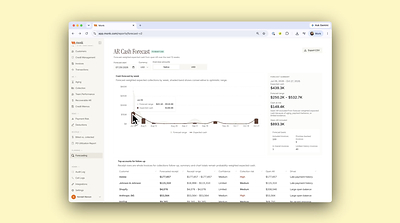
NEW YORK, July 29, 2026 /PRNewswire/ -- Monk, the AI-native accounts receivable platform, today launched Cash Forecast 2.0, which produces a live, risk-weighted forecast of expected collections, built invoice by invoice from how each customer pays rather than from flat collection-rate assumptions. The forecast updates continuously as customers reply, promise to pay, dispute, or send money, so finance teams open each week with a cash number grounded in the current state of their receivables.
The launch lands as boards are pushing finance teams to get measurable value from AI and pointing them at cash forecasting specifically. In a 2025 survey of 200 private equity sponsors and 200 portfolio CFOs, 98% of sponsors said they had directed their CFOs to prioritize AI, and 99% agreed the most effective way in is through discrete finance workstreams such as automated close, cash flow forecasting, and invoice-to-cash automation (Accordion, 2025). Most CFOs have not acted on that direction yet (Accordion, 2025). Expectations for the forecast itself are climbing at the same time, with 68% of companies reporting higher expectations for cash forecasting and the share of practitioners who expect AI to improve it rising from 65% in 2024 to 76% in 2025 (PwC 2025 Global Treasury Survey).
Adoption is common now, but results lag. Across finance, 59% of functions now use AI, yet 91% report only low or moderate impact in the early going (Gartner, 2025). Broader research points to the same pattern: AI use is widespread, but most organizations have not yet turned it into measurable business results, and the teams that do are the ones with a clear plan for where AI should work (BCG, 2026). Cash forecasting is where that value shows up on day one, because it automates a job finance was already doing by hand and sharpens the decision at the same time.
"Boards have told finance to use AI, and they have named cash forecasting as the place to start, but most teams still cannot produce a forecast they trust," said George Kurdin, Founder and CEO of Monk. "That is the gap we built Cash Forecast 2.0 to remove. When the forecast runs itself and reflects how customers pay, a finance leader stops rebuilding spreadsheets and starts making decisions. Cash flow becomes the metric they manage the business on."
How it works
Cash Forecast 2.0 builds bottom-up from each invoice's real state instead of top-down from a blended rate. Monk scores how likely each invoice is to be paid and when, using payment history, current engagement, and account context, so a customer who consistently pays 20 days late is not forecast the same way as one who pays on time. The output shows expected cash, a forecast range, and the cash at risk, along with the specific accounts most likely to move the number, so collections effort goes to the cash most likely to slip.
Because forecasting runs on the same platform as collections, the signals feed it automatically. A promise-to-pay Julia captures from an email reply and a dispute a customer just raised both flow into the forecast the moment they happen, and a paid invoice drops out immediately. The forecast works from each invoice's remaining balance and accounts for partial payments, credit memos, write-offs, and refunds, combining every signal into one calibrated score for a company's cash.
"A forecast is only useful if you can trust it, and in finance that means it has to reflect reality rather than an average," said Joe Zhou, Co-Founder and CTO of Monk. "A customer who always pays late should never be forecast like one who pays on time. Cash Forecast 2.0 reads every signal moving between a company and its customers, weights each open invoice by how that account behaves, and turns it into a number a team can plan around and a short list of the accounts worth acting on today."
What it changes for a finance team
For a finance leader, the forecast moves the work from reporting to deciding: a forward-looking view of expected collections, timing, and risk that a team can act on before the quarter closes rather than explain after. For a small team without a dedicated analyst, it delivers that same foresight without hiring for it or rebuilding a spreadsheet every week. And it changes where effort goes, concentrating follow-up on the cash the forecast flags as most likely to slip instead of the oldest or largest invoices by habit.
Monk customers already describe that shift in how they report. "The analytics and reporting have made life so much easier when it's time to report to leadership. What used to be a manual build is now a quick export," said Liam Clements, Director of Finance at Goodship.
Monk's collections agent is already proven on the accounts it runs. Across Monk's first 100 customers, Julia resolves 88.2% of collections with zero human intervention and reaches customers with a 24% higher response rate than standard dunning. Cash Forecast 2.0 turns that same live view of the receivables book into a forecast.
Availability
Cash Forecast 2.0 is available on the Monk platform now. Monk customers see a 40% or greater average reduction in DSO, and one customer, Profound, grew cash on hand by 122% in its first month after going live. Go-live typically takes one to three days, and Monk takes no percentage of the revenue it helps collect. See it in action: https://youtu.be/7czZqucM6gs.
About Monk
Monk is the AI-native accounts receivable platform that helps finance teams turn revenue into cash. Its agent, Julia, runs collections, cash application, and forecasting as one connected system. Monk resolves 88.2% of collections with zero human intervention, reaches customers with a 24% higher response rate than standard dunning, reduces DSO by more than 40%, automatically matches 80% of incoming payments with a full audit trail, and gives finance teams back roughly 26 hours a month. Teams onboard in under a week and see results in their first month. More than $1.5 billion in receivables is managed on the platform, including for customers like Profound and ElevenLabs. Monk has raised $29 million and is based in New York.
Media contact: Kendall Warson, kendall@monk.com, +1 415-827-6585
Sources: Accordion, "AI in the PE-Backed Finance Function," 2025 (survey of 200 private equity sponsors and 200 portfolio CFOs); PwC 2025 Global Treasury Survey; Gartner, "Gartner Survey Shows Finance AI Adoption Remains Steady in 2025," November 2025; BCG, "AI at Work: Why Strategy Matters More Than Tools," 2026.

 View original content to download multimedia:https://www.prnewswire.com/news-releases/monk-launches-cash-forecast-2-0--turning-receivables-into-a-live-cash-forecast-for-finance-teams-302837852.html
SOURCE Monk