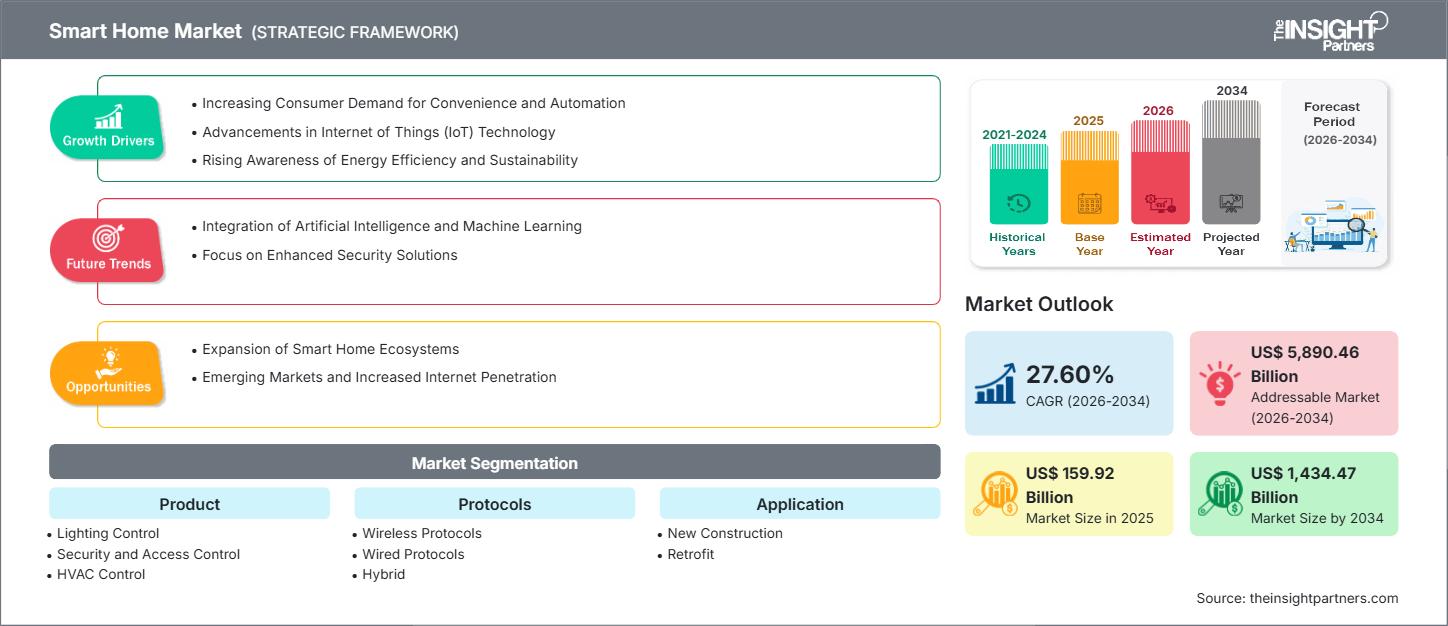
New York, June 08, 2026 (GLOBE NEWSWIRE) -- The Insight Partners, published its latest market intelligence report on the Global Smart Home Market. The study finds the market, valued at US$ 159.92 billion in 2025, is projected to reach US$ 1,434.47 billion by 2034, registering a compound annual growth rate (CAGR) of 27.6% over the 2026 - 2034 forecast period. Research draws on primary interviews with C-suite executives, smart home device manufacturers, IoT platform providers, energy utility managers, and consumer technology analysts across more than 20 countries, augmented by proprietary databases and third-party validation.
Market Overview
Smart home technologies are fundamentally reshaping residential living by integrating connected devices, sensors, and AI-driven platforms to enhance convenience, energy efficiency, security, and healthcare management. The ecosystem encompasses smart speakers, thermostats, lighting systems, security cameras, door locks, appliances, and entire home automation hubs. With the rapid proliferation of high-speed broadband, affordable IoT sensors, and generative AI assistants, smart homes are transitioning from luxury add-ons to mainstream essential infrastructure.
The US is expected to register a CAGR of 26.8% from 2026 to 2034. The United States remains the largest single-country market for smart home adoption, driven by high consumer disposable income, strong technology acceptance, and extensive partnerships between utilities and smart thermostat providers. Government incentives for energy-efficient homes and the growing integration of Matter protocol for device interoperability are further accelerating market growth.
Latest research on the Smart Home Market covers market size forecasts, growth drivers, regulatory trends, and competitive insights. You may access the Sample document here: https://www.theinsightpartners.com/sample/TIPTE100000244/
Key Market Findings
- Regional Leader: North America is forecast to account for over 32% of global market share by 2034, led by the US and Canada.
- Europe: Europe holds the second-largest share at over 28%, with the Germany market projected to grow at a 25.5% CAGR through 2034, driven by strong energy efficiency regulations.
- Dominant Product Segment: Security and Access Control is expected to hold the largest market share throughout the forecast period, driven by increasing consumer demand for smart locks, video doorbells, surveillance cameras, and remote monitoring solutions.
- Fastest-Growing Segment: Energy Management is projected to register the highest CAGR during the forecast period, supported by rising electricity costs, sustainability goals, utility incentive programs, and growing adoption of smart thermostats, intelligent lighting, and energy-monitoring devices.
- Leading Protocol Segment: Wireless Protocols dominate the market owing to ease of installation, scalability, and growing adoption of Wi-Fi, Zigbee, Z-Wave, Bluetooth Low Energy, Thread, and Matter-enabled devices.
- Leading Application Segment: Retrofit applications account for the largest market share as existing homeowners increasingly upgrade conventional residences with connected devices without requiring major structural modifications.
Primary Growth Driver: AI-Driven Personalization and Proactive Automation
The single most significant catalyst for market growth is the convergence of generative AI with smart home platforms. Unlike legacy rule-based automation, modern AI agents learn occupant behavior patterns, predict preferences, and autonomously adjust lighting, temperature, entertainment, and security settings. Voice assistants such as Amazon Alexa, Google Assistant, and Apple Siri are evolving into proactive home managers capable of scheduling maintenance, reordering supplies, and even detecting anomalies like water leaks or unusual activity. This shift from reactive control to anticipatory living is dramatically increasing user engagement and wallet share.
Energy Management: A High-Growth Vertically Integrated Opportunity
Beyond convenience and security, energy management has emerged as a critical and rapidly expanding segment within the smart home market. Smart thermostats (e.g., Nest, Ecobee), smart plugs, and intelligent lighting systems allow households to reduce energy consumption by 15–25% annually. As time-of-use electricity pricing becomes more common, smart home systems increasingly automate appliance operation during off-peak hours. Utilities are actively subsidizing smart device adoption as a grid demand-response strategy, creating a powerful channel for market expansion. The global push toward net-zero emissions by 2050 further strengthens this tailwind.
Segment Analysis
Security and Access Control - Market-Leading Product Segment
Security and Access Control is expected to remain the largest product segment throughout the forecast period. Growing concerns regarding home safety, property protection, and remote monitoring are driving widespread adoption of smart locks, video doorbells, surveillance cameras, motion sensors, and integrated alarm systems. Advancements in AI-powered threat detection, facial recognition, and cloud-based monitoring platforms continue to enhance the value proposition of smart security solutions. Increasing integration with mobile applications and voice assistants further strengthens consumer adoption across residential properties.
Energy Management - Fastest-Growing Product Segment
The Energy Management segment is anticipated to witness the highest growth rate through 2034. This segment includes smart thermostats, energy-monitoring systems, intelligent lighting controls, smart plugs, and connected power management solutions. Consumers are increasingly adopting these technologies to optimize energy consumption, reduce utility expenses, and meet sustainability objectives. Government energy-efficiency initiatives, utility rebate programs, and the expansion of renewable energy systems such as rooftop solar and battery storage are accelerating market growth.
Wireless Protocols - Dominant Protocol Segment
Wireless Protocols represent the largest share of the smart home market due to their flexibility, ease of deployment, and compatibility with a broad range of connected devices. Technologies such as Wi-Fi, Zigbee, Z-Wave, Bluetooth Low Energy, Thread, and Matter enable seamless communication among smart home devices while reducing installation complexity and infrastructure costs. Growing consumer preference for DIY smart home solutions continues to drive adoption of wireless connectivity platforms.
Check Discount details - https://www.theinsightpartners.com/discount/TIPTE100000244/
Regional Analysis
North America - Largest Market Sustained by High Consumer Tech Spend
North America dominates the global market and is projected to account for over 32% of the total market share by 2034. The United States remains the single largest national market, with its smart home market forecast to grow at a 26.8% CAGR through 2034. High broadband penetration, strong retail availability, and the presence of platform leaders (Amazon, Apple, Google) are key drivers. Canada follows a similar trajectory with additional emphasis on smart energy management due to colder climates and hydro-electric pricing structures.
Asia Pacific - Fastest-Growing Market
Asia Pacific is the fastest-growing regional market, registering a projected CAGR of 30.2% through 2034. China is the largest national market in the region, driven by Xiaomi, Huawei, and Alibaba’s smart ecosystem strategies. India is the fastest-growing major economy in the segment, with rising middle-class disposable income, smartphone penetration, and government smart city initiatives. Japan, South Korea, Australia, and Southeast Asian nations are also experiencing rapid adoption fueled by aging-in-place technology needs (smart health monitoring) and air quality management.
Market Dynamics: Key Opportunities and Challenges
Aging-in-Place and Remote Healthcare Integration: As the global population ages, smart home devices are increasingly being deployed for passive health monitoring, fall detection, medication reminders, and emergency response. Sensors embedded in smart speakers, lighting, and wearables can detect changes in activity patterns that may indicate emerging health issues. This capability reduces the burden on formal healthcare systems and allows seniors to live independently longer. Insurance providers are beginning to offer premium discounts for smart home safety and health monitoring systems.
Interoperability and Fragmentation Challenges: Despite progress with the Matter standard, the smart home market remains fragmented across multiple ecosystems (Alexa, Google Home, Apple HomeKit, Samsung SmartThings). Consumers face frustration when devices from different manufacturers fail to work seamlessly together. This fragmentation can slow mass-market adoption, as less tech-savvy users perceive setup and maintenance as overly complex. The industry is actively consolidating around common standards, but the transition remains incomplete.
Purchase the full report from The Insight Partners - https://www.theinsightpartners.com/buy/TIPTE100000244/
Recent Industry Developments (2025 - 2026)
Johnson Controls Unveils Fifth-Gen DSC & IQ Security Panels
In March 2026, Johnson Controls (NYSE: JCI), a global technology leader in energy efficiency, decarbonization, thermal management and mission-critical performance, introduced the fifth generation of both its DSC PowerSeries Neo security system and its IQ Panel, bolstering the company’s intrusion detection capabilities for residential and commercial settings to protect what matters most.
ABB Launches System Access Point 3.0 Wireless for Smart Homes
In February 2026, ABB launched the new System Access Point 3.0 Wireless at Light + Building 2026, extending ABB-free@home Wireless with greater scale, secure remote access, and broader smart home integration. The solution was designed to help installers deliver reliable in-home control and scale projects easily as needs grew.
Siemens Partners with ADMARES on Digital Twin for Sustainable Housing
In September 2025, Siemens announced that ADMARES, a leader in industrialized housing, is using the Siemens Xcelerator open business platform to apply Siemens’ most comprehensive digital twin, advanced manufacturing and automation technology to design, build and operate sustainable and affordable housing.
Leading Smart Home Companies
| Company | Profile |
| ABB Ltd. | Provides smart home and building automation solutions, including energy management, lighting control, security systems, and connected residential infrastructure through its ABB-free@home platform. |
| ADT Inc. | Offers smart home security, video surveillance, access control, intrusion detection, and professionally monitored home automation services. |
| Assa Abloy AB | Global leader in smart locks and digital access solutions through brands such as Yale and August, serving residential and multi-family housing markets. |
| Honeywell International Inc. | Develops smart thermostats, home security systems, air quality monitoring, and connected home automation solutions under the Honeywell Home brand. |
| Johnson Controls International plc | Provides smart residential and building management systems, integrating security, HVAC controls, energy optimization, and connected living solutions. |
| Legrand | Offers connected lighting, smart switches, energy management, home automation, and digital infrastructure products for residential applications. |
| Robert Bosch GmbH | Delivers smart home solutions including security cameras, sensors, thermostats, lighting controls, and IoT-enabled home automation devices. |
| Schneider Electric SE | Provides the Wiser smart home platform focused on energy efficiency, smart electrical systems, home automation, and sustainability. |
| Samsung Electronics Co., Ltd. | Operates the SmartThings ecosystem, offering connected appliances, smart displays, security devices, and comprehensive home automation solutions. |
| Siemens AG | Offers smart building and residential automation technologies, including energy management, intelligent controls, and connected infrastructure solutions. |
About The Insight Partners
The Insight Partners is a globally recognized market research and management consulting firm specializing in technology, media, telecommunications, healthcare, and industrial sectors. Research methodology integrates primary data collection, including executive interviews, OEM surveys, and channel partner analyses, with proprietary secondary research databases and econometric modeling. Reports are used by Fortune 500 companies, private equity firms, government agencies, and institutional investors to inform strategic planning, M&A, and capital allocation decisions. The firm maintains research coverage across 50+ industries and 100+ countries.
Report Link: https://www.theinsightpartners.com/reports/smart-home-market
Request for a free demo of The Insight Partners’ Smart Home Market & Intelligence Platform
Media Contact: The Insight Partners | sales@theinsightpartners.com | www.theinsightpartners.com
Also Available in : Korean | German | Japanese | French |Chinese | Italian | Spanish